

Last Updated: November 22, 2026
Quick Summary
Shilajit cognitive benefits are not yet proven. Laboratory and animal studies suggest plausible mechanisms, but human evidence is limited to small, short trials with modest, unproven effects on memory or focus.
- Most shilajit research is laboratory or animal work, not human trials.
- Human studies are small and short, with inconsistent formulations.
- No study shows shilajit prevents cognitive decline or treats a cognitive disorder.
- Study doses vary widely, and resin products are not standardized.
- Effects, if any, were assessed after several weeks, so allow a defined trial period.
Table of Contents
- What Shilajit Is and Why People Use It for Cognitive Performance
- What the Research Says About Memory, Focus and Mental Clarity
- Shilajit for Brain Fog: Realistic Expectations
- Shilajit Dosage Used in Studies and How Long Before Effects Appear
- Shilajit Side Effects, Interactions and Medical Cautions
- How to Verify Purified Shilajit Resin Before You Buy
- Frequently Asked Questions
What Shilajit Is and Why People Use It for Cognitive Performance
Whether shilajit cognitive performance benefits are real is a question many people now ask after hearing about it in wellness circles. Shilajit is a dark, tar-like resin that seeps from rock in mountainous regions, and it has a long history in Ayurvedic medicine. Its composition is largely humic substances, including fulvic acid, along with a range of minerals.
Interest in shilajit for cognitive performance rests mostly on its fulvic acid and mineral content, along with claims about antioxidant and energy-supporting effects. Those claims are plausible, but they are not the same as proof. This article sorts what studies have examined from what marketing tends to imply.
At MushLuvv, we sell a single-ingredient Live Resin Shilajit and think it helps to know what the research can and cannot support before you buy any shilajit product.

What the Research Says About Memory, Focus and Mental Clarity
Most of the research on shilajit cognitive effects is early, and the quality varies enormously by study type. That matters because a headline about "shilajit and the brain" can come from a petri dish, a mouse, or a small human trial, and those are not equivalent evidence. Reviews of the field routinely note that human data are limited and that study designs differ widely National Center for Biotechnology Information review of shilajit pharmacology.
The most useful way to read the evidence is to grade it by study type before you weigh any claim about memory, focus, or mental clarity.
Human trials versus laboratory and animal studies
Laboratory work shows plausible mechanisms. Shilajit and its fulvic acid fraction have been studied for antioxidant activity, effects on oxidative stress markers, and inflammatory signaling in cells and tissue. Animal studies have examined things like memory performance in maze tasks and markers of mitochondrial function. Those findings are real, but they do not automatically translate into measurable thinking improvements in healthy adults.
Human evidence is much thinner. A small number of trials in people have reported modest changes on cognitive measures, often alongside other outcomes like fatigue or general well-being. Those results are encouraging but limited by small samples, short durations, and inconsistent formulations.
Which cognitive outcomes studies actually measured
Where human studies exist, they tend to use standardized tests rather than vague descriptions. Common endpoints include memory recall tasks, attention or vigilance tests, reaction time, and processing speed. Some trials have looked at self-rated measures of mental clarity or fatigue, which are easier to collect but weaker as evidence because they depend on how participants feel rather than on objective performance.
A useful question to ask of any cited study is which specific test was used and how large the change was. A statistically significant change on a reaction-time task can still be small in practical terms. Vague terms like "mental clarity" are hard to verify, and no study has shown that shilajit prevents cognitive decline or treats a diagnosed cognitive disorder.
What the evidence does and does not support
Put simply, the evidence supports a plausible mechanism and some early, low-to-moderate quality human signals, not a proven memory or focus treatment. The strongest claims you will see online usually outrun the studies behind them. A fair summary is that shilajit may support general well-being in some people, and that any cognitive effect is unproven and likely modest at best.
Shilajit for Brain Fog: Realistic Expectations
Brain fog is not a diagnosis, and it has many possible causes, including poor sleep, stress, medication effects, thyroid problems and nutritional gaps. Shilajit is unlikely to address the underlying cause in most cases. People who report feeling clearer on it are often also changing sleep, diet or stress levels at the same time.
A realistic expectation is that shilajit may provide mild support for someone whose fatigue is largely lifestyle-related, and it should not replace a medical evaluation. For a deeper, evidence-focused guide to judging whether a supplement is worth it, read how to tell if dual extracted mushrooms are worth it. For more practical approaches to try alongside or instead of supplements, see our guide to clearing brain fog naturally.
Shilajit Dosage Used in Studies and How Long Before Effects Appear
There is no established standard dose of shilajit for cognitive effects, and that is not a dodge, it reflects how the research has been done. Study doses vary widely, formulations differ, and the amount of fulvic acid in a given gram of resin is not standardized across products. A gram of one resin is not equivalent to a gram of another.
What the studies actually used
Those details matter because a dose studied in a purified extract does not map cleanly onto a scoop of resin. If a product does not state its fulvic acid content or its standardization, you cannot compare it to a study dose at all.
How long before effects appear
Effects, if any, are usually described as gradual. In the trials that reported cognitive or fatigue outcomes, changes were generally assessed after several weeks rather than days. A few weeks is a reasonable window before deciding whether a product is doing anything for you, and a defined trial period with one or two concrete observations, sleep quality, mid-afternoon energy, or performance on a simple reaction-time test, is more useful than a vague sense of feeling better.
Watch out: Do not copy a study dose onto a product with a different formulation or fulvic acid content, and do not exceed the serving directions on the label in hopes of faster results.
A practical way to set expectations
Follow the serving directions on the specific label, start conservatively, and give it a defined trial period. If you notice no change after several weeks, there is little reason to continue. And if you take prescription medication or have a health condition, set the dose question aside and talk to a clinician first.
Shilajit Side Effects, Interactions and Medical Cautions
Shilajit is generally described as well tolerated in short-term use, but side effects such as stomach upset or headache have been reported. Its mineral content also means that people with certain conditions, including kidney or liver disease, iron disorders or those on blood-thinning or diabetes medication, should speak with a clinician before use.
Pregnant or breastfeeding women, and anyone taking prescription medication, should check with a doctor first. Supplements are not evaluated by the FDA for safety or effectiveness before they are sold, which is why medical advice matters here FDA guidance on dietary supplements.
Watch out: Do not stop prescribed medication or replace a diagnosis-based treatment plan with shilajit on the assumption that it will help cognition.
How to Verify Purified Shilajit Resin Before You Buy
Because shilajit is harvested from the ground, purity and contamination matter. Look for a product that states its sourcing and processing clearly, and check whether it has been tested by an independent lab for heavy metals, microbes and pesticides. A batch-specific certificate of analysis is the most useful document to request.
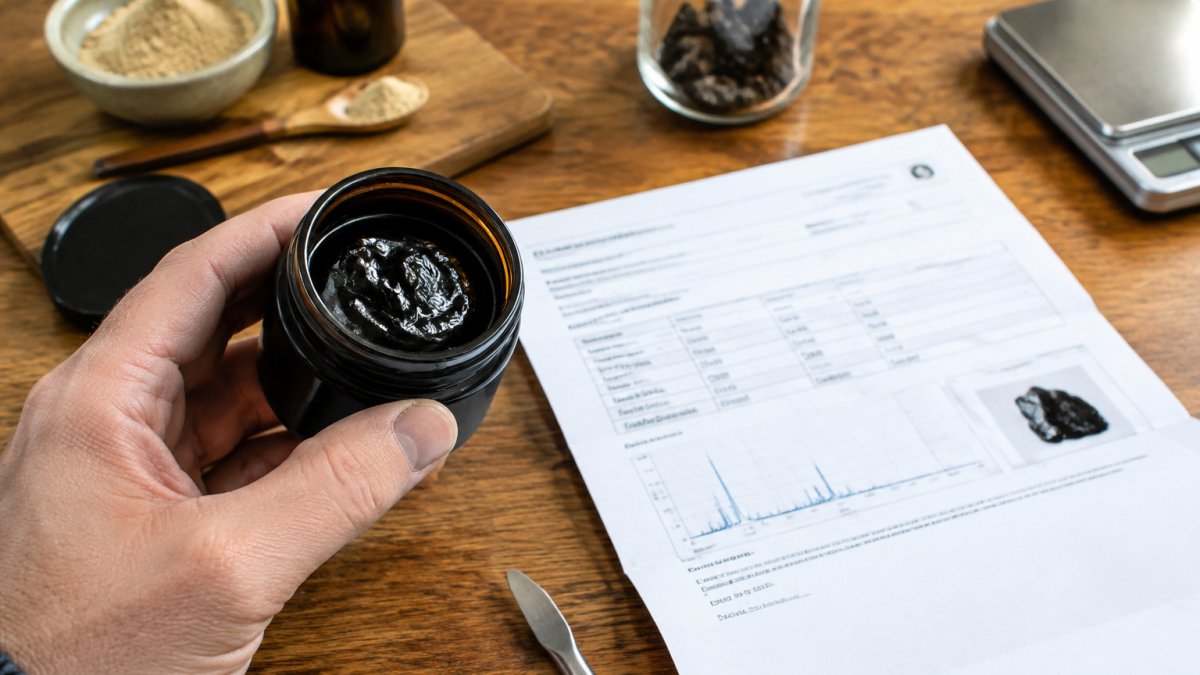
Our Live Resin Shilajit is a single-ingredient resin, and a Certificate of Analysis (COA) is available via QR code. Understanding why third-party lab testing matters will help you read those documents. Many shoppers also ask whether third-party tested shilajit brands are worth buying, and it is a fair question to weigh against price.
| Check | What to look for |
|---|---|
| Ingredient list | Single ingredient, no fillers |
| Lab testing | Independent, batch-specific report |
| Contaminants | Heavy metals, microbes, pesticides listed |
| Price | Compare cost per serving, around $29.99 for our resin |
The resin is sold at $29.99 per jar. Compare cost per serving rather than price alone, since serving sizes differ between brands.
Shilajit is best viewed as a supplement with modest, unproven potential for cognitive support, not a proven memory or focus treatment. Buy from a source that shows its testing, start with a conservative amount and talk to a clinician if you have a health condition or take medication.
Please consult a qualified healthcare professional before starting any new supplement.
Frequently Asked Questions
Does shilajit improve brain function?
The evidence is promising but limited. A small number of human trials and a larger body of laboratory and animal work suggest shilajit may support memory and mental performance, but human studies are limited and few measure cognition with standardized tests. Treat it as an open question rather than a proven cognitive enhancer, and judge any product claim against the studies behind it.
How much shilajit should you take for cognitive support?
Follow the serving directions on the label and do not exceed them. Stirring a measured amount into warm water or tea is the usual method. Because study doses and populations vary, the dose that worked in one trial may not translate directly to you, so start with the lowest serving listed.
What are the side effects of shilajit?
Shilajit is generally well tolerated in the studies available, but side effects such as stomach upset, headache or a flushed feeling have been reported. Quality matters here: products with heavy metal contamination carry a separate risk. Stop use and talk to a doctor if you notice unusual symptoms. Pregnant or breastfeeding women, people with kidney, liver or thyroid conditions, and anyone taking prescription medication should check with a healthcare provider first.
How can you tell whether shilajit is purified and tested?
Look for a current Certificate of Analysis (COA) from an independent laboratory that tests for heavy metals, toxins and pesticides, and confirm the batch number on the COA matches your jar. MushLuvv makes its COA available via QR code for its Live Resin Shilajit, which is one useful check. A label that says 'pure' with no lab results is not verification on its own.
