

Last Updated: November 5, 2026
Quick Summary
A lion's mane supplement is worth the price only when you compare cost per daily serving, not the bottle price, and choose a fruiting body extract over grain-based mycelium. MushLuvv's 100g fruiting body extract powder is listed at $24.99, but its real value depends on the suggested serving size on the current label.
- Calculate cost per daily serving: bottle price divided by servings per container and servings taken daily.
- Count servings per container rather than capsules, since a 2-capsule serving halves the count.
- Mycelium products often include grain, so they may deliver less mushroom than their milligram weight suggests.
- Fruiting body extracts with disclosed beta-glucan content give a more concrete quality signal than raw milligrams.
- Most human evidence is limited and mixed, so treat supplement benefit claims with caution.
Table of Contents
- What You Actually Pay for a Lion's Mane Supplement
- Cost Per Daily Serving: How to Compare Lion's Mane Prices Fairly
- Fruiting Body Extract, Mycelium, or Whole Mushroom: Which Is Worth Your Money
- What the Evidence Says About Lion's Mane Benefits
- Side Effects, Safety Checks, and How to Pick the Best Lion's Mane Supplement for Your Budget
- Deciding Whether a Lion's Mane Supplement Is Right for Your Routine
- Frequently Asked Questions
Lion's mane supplements vary widely in price, which makes the question of value hard to answer at a glance. MushLuvv sells a 100g full fruiting body extract powder for $24.99, and this guide explains how to decide whether that kind of price is worth paying for lion's mane supplement use at home. We'll compare cost per serving, extract types, the limits of the current evidence, and the safety checks that matter before you buy.
What You Actually Pay for a Lion's Mane Supplement
Lion's mane supplements come in several formats, including capsules, tinctures, and loose powders. The sticker price alone rarely tells you much, because bottle size, serving size, and extract strength all change the math. MushLuvv's Lion's Brain Organic Lion's Mane Extract Powder, a 100g full fruiting body extract, is listed at $24.99 on the brand's site. Check the current listing before you buy, since prices can change.
Cost Per Daily Serving: How to Compare Lion's Mane Prices Fairly
Bottle price is the least useful number on a lion's mane label. What you actually pay for is a daily dose, and that figure changes dramatically with serving size, extract strength, and capsule count.
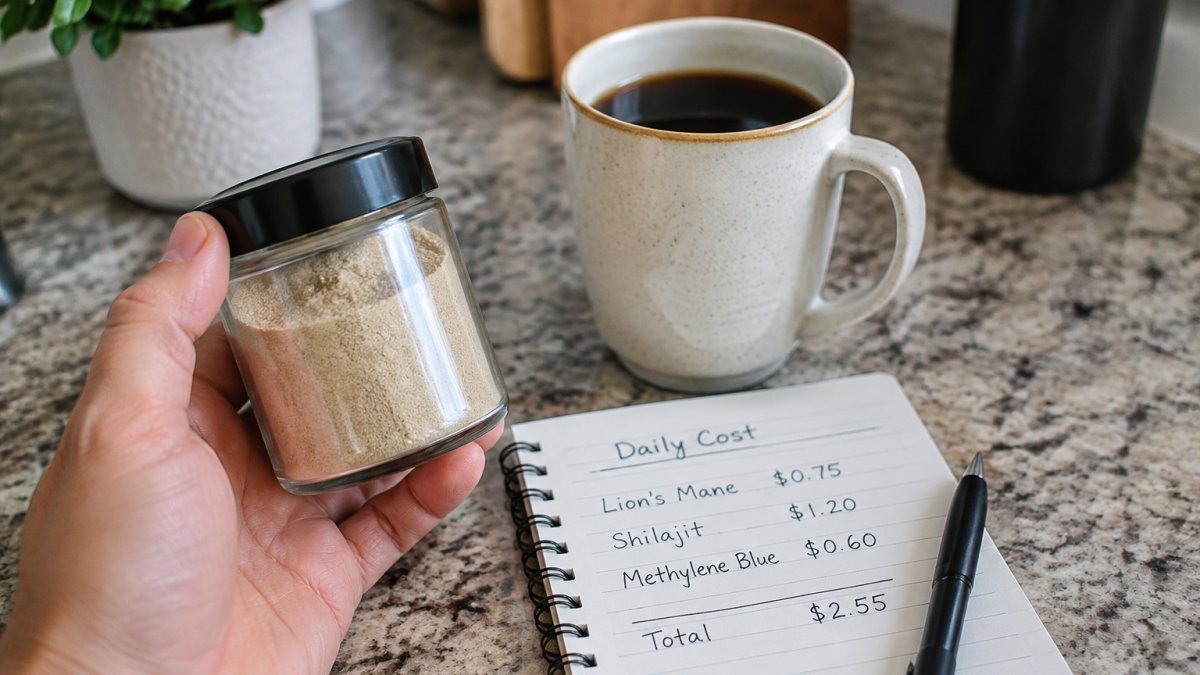
The formula is simple: cost per daily serving = bottle price ÷ (servings per container × servings you actually take per day). Run it in this order so you don't get fooled by headline milligrams:
- Find the serving size on the Supplement Facts panel. It may be one capsule, two capsules, or a scoop of powder, not necessarily one dose.
- Count servings per container, not capsules. A 120-capsule bottle with a 2-capsule serving holds 60 servings, not 120.
- Check the extract strength and beta-glucan content. A 1,000 mg capsule of a 1:1 whole mushroom powder is not equivalent to 1,000 mg of a concentrated fruiting-body extract. If the label discloses beta-glucans (the polysaccharide fraction most often used to gauge extract quality), compare that number across products rather than the raw milligram weight.
- Adjust for how many servings you actually take. If the label suggests two servings a day and you follow that, double your per-serving cost.
MushLuvv's Lion's Brain Organic Lion's Mane Extract Powder is a 100 g full fruiting body extract listed at $24.99. Confirm the suggested serving size on the current label before you calculate its daily cost, since it determines the real figure.
Watch out: a low bottle price paired with a tiny serving size, a proprietary blend that hides individual extract amounts, or a mycelium-on-grain product marketed as "mushroom" can make the per-day cost look better than it is. Do the division before you compare, and treat any product that won't disclose servings per container as a red flag.
The steps below show how to turn a bottle price into a fair cost per daily serving.
| Step | What to do | Note |
|---|---|---|
| Find serving size | Read the Supplement Facts panel | May be one capsule, two, or a scoop |
| Count servings | Divide capsules by capsules per serving | A 120-capsule bottle may hold 60 servings |
| Check extract strength | Look for beta-glucan content | Compare beta-glucans, not raw milligrams |
| Adjust for intake | Multiply cost if you take extra servings | Suggested dose may be two servings a day |
| Calculate cost | Bottle price ÷ (servings × daily servings) | Run this before comparing products |
Fruiting Body Extract, Mycelium, or Whole Mushroom: Which Is Worth Your Money
Lion's mane reaches the market in three broad forms, and the form you buy determines both what you pay and how much of that price reflects actual mushroom. Understanding the difference is the single biggest lever on whether a supplement is worth its cost.
Fruiting body is the mushroom itself, the part you would cook and eat. Fruiting-body extracts are made by pulling water-soluble compounds out of the dried mushroom, often with hot water and sometimes with alcohol, then drying the result into a powder or filling it into capsules. MushLuvv's Lion's Brain product is a 100% fruiting body extract with no mycelium or fillers.
Mycelium is the root-like network the mushroom grows from. Much commercial mycelium is cultivated on grain (often brown rice or oats), and the harvested material includes both mycelium and the residual grain. That grain is starch, not mushroom, so a mycelium product can show a high milligram weight while delivering a smaller share of mushroom-derived compounds. Mycelium products are usually cheaper per gram for exactly this reason. They are not automatically inferior, some research uses mycelium, but you should know you are paying partly for grain.
Organic Lion's Mane Extract Powder | 100g | Full Fruiting Body | MushLuvv's →
Whole mushroom powder is dried, ground mushroom without a concentration step. It is closer to a food ingredient than to an extract, so it is priced and labeled differently. It can be a reasonable culinary addition, but gram-for-gram it delivers less concentrated material than an extract, and its per-day cost should be judged on that basis.
Two label details help you judge a product:
- Extract ratio and beta-glucan disclosure. An extract ratio (such as 8:1) tells you how much raw mushroom went into each unit of extract. Beta-glucan content, when disclosed, is a more concrete quality signal than total milligrams because it reflects the polysaccharide fraction many buyers use to gauge extract strength. A product that lists neither is asking you to pay for a claim you cannot verify.
- Grain and filler disclosure. Look for language stating the product is 100% fruiting body, or that it is grown on a defined substrate. Vague "mushroom complex" or "mycelium blend" wording often signals grain fillers.
On the evidence side, most human studies of lion's mane have used specific fruiting-body or mycelium extracts at defined doses, while laboratory and animal work covers a wider range of preparations. Separate what human trials support from what animal and lab studies suggest.
Watch out: a product labeled "mushroom" that lists mycelium and grain on the ingredient panel is not the same purchase as a fruiting-body extract. Match the form to the evidence you care about, then compare cost per daily serving within that form, not across it.
What the Evidence Says About Lion's Mane Benefits
Lion's mane is most often discussed for its potential effects on memory, focus, and nerve health. Much of the research so far comes from laboratory and animal studies, and the human evidence remains limited and mixed. Treat any supplement claim with caution.
Side Effects, Safety Checks, and How to Pick the Best Lion's Mane Supplement for Your Budget
Lion's mane is generally considered well tolerated, but some people report stomach upset or allergic reactions. Talk to a healthcare provider before starting if you're pregnant, nursing, managing a medical condition, or taking medication. When comparing products, look for third-party testing results and a clear certificate of analysis, and avoid brands that make claims the evidence doesn't support. Watch out: a low price can signal a product that is under-dosed or poorly sourced, so check the extract type and label details before choosing on cost alone.
Deciding Whether a Lion's Mane Supplement Is Right for Your Routine
Whether a lion's mane supplement is worth the price depends on whether the format matches what you want, the cost per daily serving fits your budget, and the product is transparently tested. MushLuvv's Lion's Brain powder is priced at $24.99 and can be compared against other fruiting body extracts. Shop the Lion's Brain Organic Lion's Mane Extract Powder to see the size and price before you decide.

Frequently Asked Questions
Is Lion's Mane worth the money?
It depends on what you are comparing. Lion's mane supplements range widely in price, so the useful measure is cost per daily serving rather than cost per bottle. A lower sticker price can still be poor value if the product uses mycelium grown on grain rather than fruiting body, or if the label does not state extract strength. MushLuvv's Lion's Brain is a 100g full-spectrum fruiting body powder priced at $24.99. Human evidence on cognitive benefits is still limited, so set expectations accordingly.
Why is Lion's Mane so expensive?
Cost is driven mainly by how the mushroom is grown and processed. Fruiting bodies take longer to cultivate than mycelium grown on grain, and extraction and third-party testing add cost. When comparing, check whether the price reflects fruiting body content, extraction method, and a published Certificate of Analysis, rather than only the weight in the container.
What are the downsides or side effects of Lion's Mane supplements?
Lion's mane is generally well tolerated, but some people report digestive discomfort, such as gas or loose stools, especially when starting at a high dose. Because it can affect immune and blood-sugar pathways in some studies, people who take immunosuppressants, blood thinners, or diabetes medication, or who have a mushroom allergy, should check with a doctor first. Start with a small serving, increase gradually, and stop if you notice any reaction.
Is Lion's Mane powder cheaper than capsules?
The real comparison is cost per daily serving. Capsules are convenient and make dosing precise, while powder lets you control the amount and mix it into coffee, tea, or smoothies. Compare both formats using the same extract strength and daily amount.
